
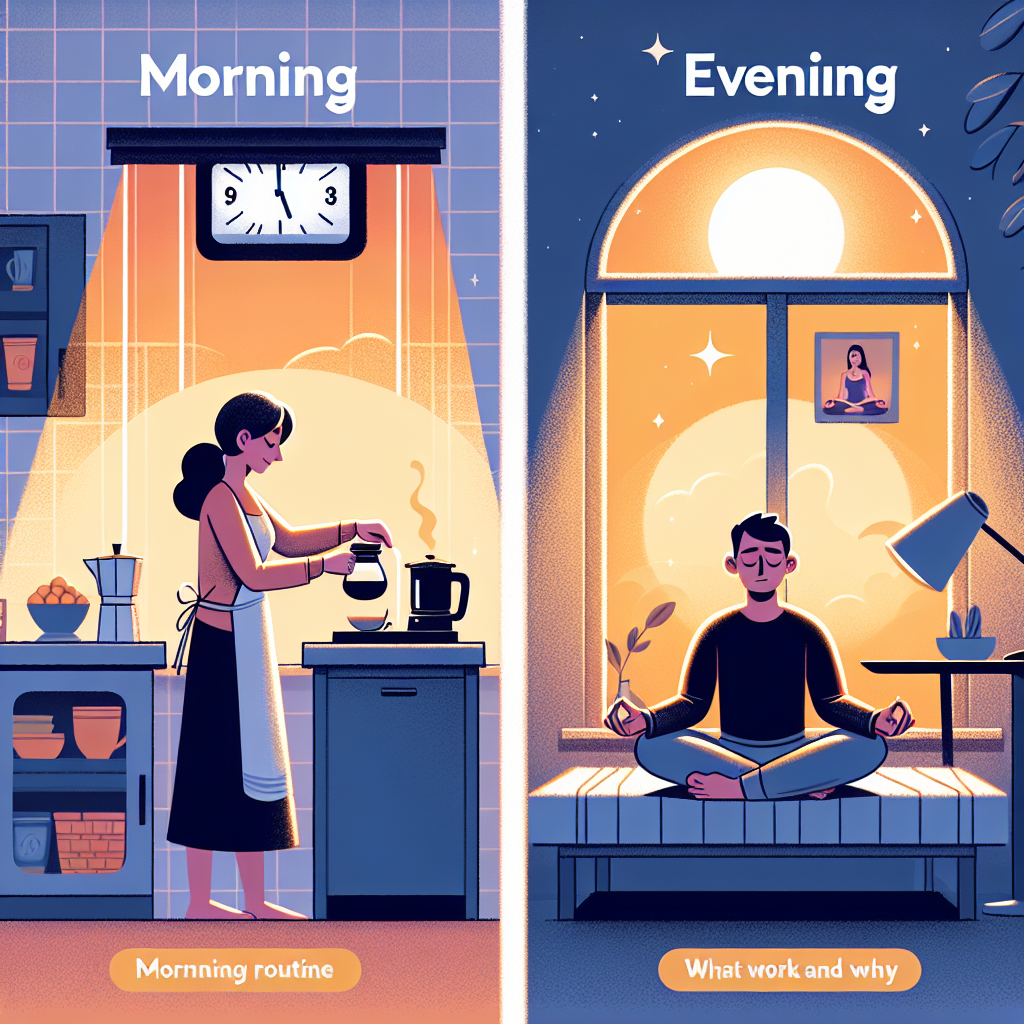
Use your body clock, not willpower, to make habits stick and days flow.
Quick summary
- Morning routines shine for momentum, focus, and consistency. Morning light anchors your body clock and early wins reduce decision fatigue.
- Evening routines shine for recovery, planning, and protecting sleep. A good night routine makes tomorrow easier than any morning hack.
- Your chronotype matters: early “larks” do best with AM deep work; late “owls” often place deep work later and use mornings for admin/recovery.
- Pick one keystone in each: a 10–20 minute morning anchor plus a 20–40 minute evening wind‑down beats a perfect but fragile 90‑minute ritual.
Why routines work
- Fewer choices, less friction: Repeating the same cues and actions reduces decision fatigue and context switching.
- Habit loops: Stable cues (time, place, trigger) link to actions and rewards, reinforcing a predictable loop.
- Circadian biology: Cortisol peaks in the morning to promote alertness; melatonin rises in the evening to signal sleep. Light, meals, movement, and timing all shift this rhythm.
- Energy matching: Cognitive tasks and physical performance fluctuate over the day. Aligning work with your personal energy curve yields outsized gains.
Morning routines: strengths and structure
What mornings are typically best for
- Anchoring your clock: Sunlight within 30–60 minutes of waking stabilizes sleep timing and boosts alertness.
- Momentum and deep work: Many people get their most uninterrupted focus early, before the day’s inputs accumulate.
- Consistency habits: Brief exercise, journaling, or planning are easier to protect before emergencies arise.
Core elements to consider
- Light and movement: Natural light exposure; a short walk or mobility to raise core temperature.
- Hydration and protein: Water first; caffeine 60–90 minutes after waking can avoid a mid‑morning crash.
- Plan the day: Review top 1–3 priorities; set a protected first work block; schedule breaks.
- Boundaries: Avoid reactive inputs (notifications, email) until after your first planned task.
Sample morning routines
10–15 minutes (busy days)
- Water + 3 deep breaths at a window (1 minute)
- Light exposure: step outside or bright window (3 minutes)
- Micro‑mobility or brisk walk in place (3 minutes)
- Write top 1–3 priorities and first next action (3 minutes)
- Start the first 10–25 minute focus block (if time allows)
30 minutes
- Water, light, light movement (8 minutes)
- Journaling or gratitude + day preview (7 minutes)
- Skill or deep work sprint (10 minutes)
- Prep protein‑forward breakfast / caffeine if desired (5 minutes)
60 minutes
- Walk outside or cardio warm‑up (15 minutes)
- Strength or mobility (15 minutes)
- Shower and get ready (10 minutes)
- Plan: priorities, blocks, and boundaries (10 minutes)
- Start first deep work block device‑free (10 minutes)
Exercise timing note: Adherence is often higher in the morning. Peak strength/power typically occurs late afternoon; choose morning for consistency or weight management, later for peak performance if sleep isn’t disrupted.
Evening routines: strengths and structure
What evenings are typically best for
- Recovery and sleep: Winding down, dimming lights, and managing temperature signal your brain to shift toward sleep.
- Reflection and planning: A brief review reduces rumination and offloads tasks from your mind.
- Preparation: Lay out clothes, pack bags, stage breakfast/coffee—tomorrow’s frictions disappear.
Core elements to consider
- Digital sunset: Reduce bright/blue light and stimulating media 60–90 minutes before bed.
- Environment: Dim lighting, cooler bedroom, tidy surfaces, blackout curtains if needed.
- Mind quieting: Low‑intensity reading, stretching, breathwork, or a warm shower.
- Tomorrow setup: 5–10 minute “shutdown” checklist to finalize plans and reset spaces.
Sample evening routines
15–20 minutes (busy nights)
- Digital off or night mode (now)
- 5‑minute tidy and tomorrow prep (clothes, bag, breakfast)
- 3–5 minutes of stretching or breathing
- Paper note to capture loose thoughts; set wake alarm
30 minutes
- Dim lights; warm shower or bath (10 minutes)
- Shutdown ritual: review today, pick tomorrow’s top 3, calendar check (10 minutes)
- Light reading or relaxation exercise (10 minutes)
45–60 minutes
- Kitchen close + light stretch (15 minutes)
- Reflection journaling + gratitude + plan (15 minutes)
- Hobby or calm connection time; screens dimmed (15 minutes)
- Breathing, meditation, or yoga nidra (10–15 minutes)
Exercise timing note: Moderate exercise late afternoon/early evening can aid sleep for many; very intense efforts close to bedtime can delay sleep for some. Leave a 2–3 hour buffer if you notice issues.
Chronotypes and personalization
- Larks (early types): Schedule deep work soon after a short AM routine. Keep evenings simple and protective of an earlier bedtime.
- Owls (late types): Use mornings for light, movement, and setup; place deep work mid‑day to evening. Wind‑down starts later but should still be consistent.
- “Third birds” (intermediate): You have flexibility—let work and family constraints guide your anchor choices.
- Shift workers and parents: Prioritize a shortened wind‑down to protect sleep opportunities; keep pre‑sleep rituals consistent even when clock times change.
How to choose and design yours
- Define your primary goal: focus, fitness, stress, learning, or sleep quality.
- Map your energy for a week: note when you feel most alert, creative, and physically strong.
- Pick one keystone per routine: e.g., morning light + first focus block; evening shutdown + dim lights.
- Start tiny: 5–15 minutes beats 0 minutes. Stack habits gradually.
- Make it obvious and easy: stage clothes, prep tools, use checklists and alarms as cues.
- Review weekly: keep what works, cut what doesn’t, and adjust timing by 15–30 minutes if needed.
Common pitfalls and fixes
- Overstuffing: If it doesn’t fit on a Post‑it, it won’t fit in your morning. Trim to essentials.
- All‑or‑nothing thinking: Create “bronze” versions for chaotic days (5–10 minutes).
- Phone‑first mornings: Put the phone in another room or use app limits until your first task starts.
- Late caffeine and screens: Cut caffeine 8 hours before bed; use warmer, dimmer light after sunset.
- Too‑late workouts: If sleep suffers, move intense sessions earlier or reduce intensity at night.
- Skipping the wind‑down: Even 10 minutes of shutdown planning can halve morning friction.
Example routines by goal
Productivity
- Morning: light + movement, then a 25–50 minute deep work sprint before email.
- Evening: 10‑minute shutdown (capture, prioritize top 3, calendar), tidy workspace.
Fitness
- Morning: short mobility and brisk walk; strength if consistency is hard later.
- Evening: full workout if you perform better later; keep a 2–3 hour buffer before bed.
Stress and sleep
- Morning: gratitude or breathing, outside light, light movement.
- Evening: dim lights, warm shower, gentle stretch or meditation, paper brain dump.
Learning/creative work
- Morning: focused study block; avoid inputs first.
- Evening: review notes; low‑stakes idea capture—let diffuse thinking incubate overnight.
FAQ
How long should a routine be? Long enough to deliver its main benefit, short enough to be repeatable. Many people thrive with 15–30 minutes in the morning and 20–40 minutes in the evening.
Do I need both? One strong evening wind‑down plus a minimal morning anchor often outperforms an elaborate morning routine alone.
What if I can’t wake up early? Don’t fight your biology. Use morning light and a short primer, place deep work at your real peak, and guard your wind‑down.
Travel or jet lag? Get outside morning light at the new destination, anchor meals to local time, keep a compact wind‑down, and avoid long naps late day.
Parents and unpredictable schedules? Build “micro‑routines” tied to events (after the first diaper, after school drop‑off) rather than fixed times.
Further reading
- Circadian rhythm basics: the roles of light, melatonin, and cortisol in sleep/wake timing.
- Habit formation research: cue–routine–reward loops and environment design for behavior change.
- Exercise timing: performance peaks typically late afternoon; adherence often higher in mornings.
- Sleep hygiene: temperature, light, and pre‑sleep arousal management to improve sleep quality.
Note: This article is educational and not medical advice. If you have sleep disorders or health conditions, consult a healthcare professional.