
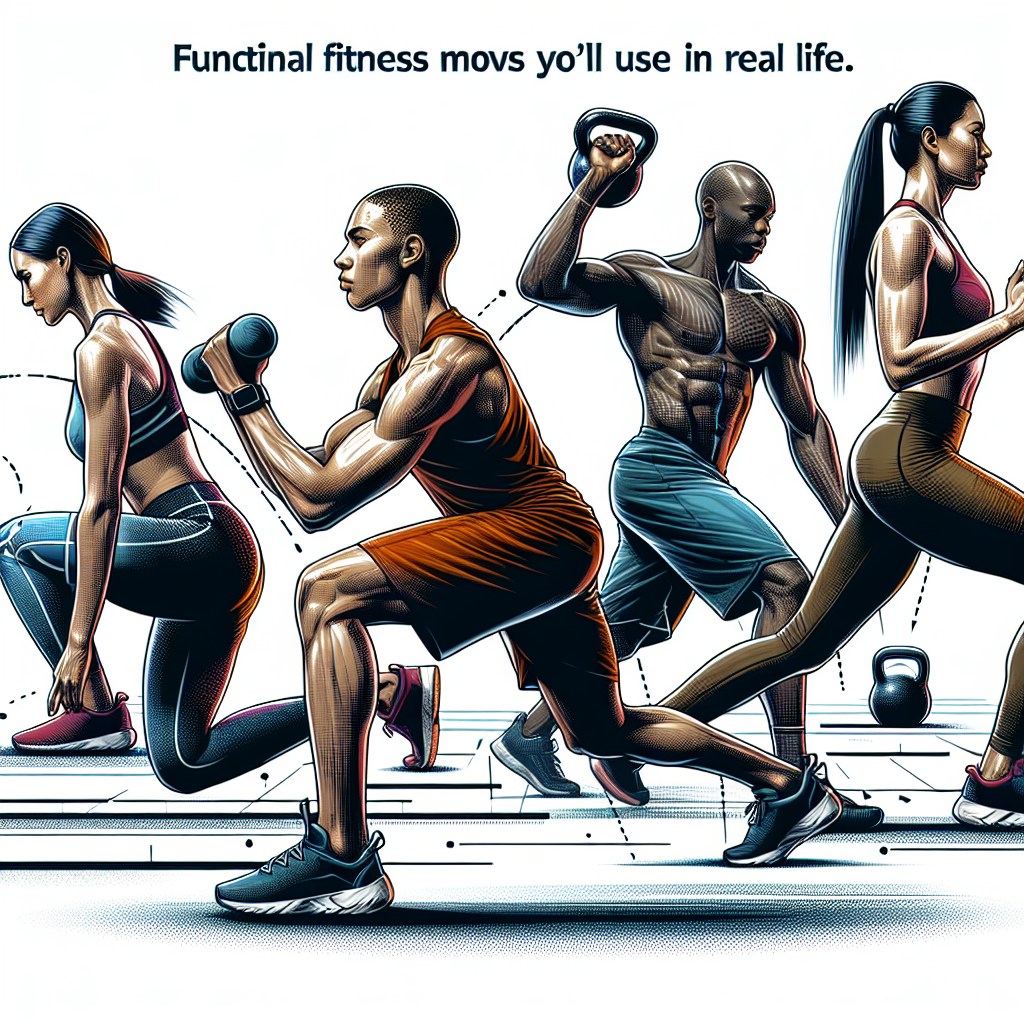
Functional fitness trains the movement patterns you rely on every day—standing, lifting, carrying, pushing, pulling, and rotating—so you can live, work, and play with less pain and more energy.
Why Functional Fitness Matters
- Builds strength where you need it: stairs, groceries, kids, yardwork.
- Improves balance, posture, and joint resilience to reduce injury risk.
- Reinforces mobility and stability for efficient, confident movement.
- Supports healthy aging and performance in sports and work.
Think “patterns,” not muscles. Train your body to work as an integrated system—core, hips, shoulders—to transfer force safely and powerfully.
The 8 Foundational Movement Patterns
1) Squat
Everyday uses: Sitting and standing, getting out of a car, picking up a box from knee height.
How: Feet shoulder-width, tripod feet (big toe, little toe, heel). Brace lightly. Hips and knees bend together, torso tall, knees track over mid-foot. Stand by driving through the floor and squeezing glutes.
- Cues: “Ribs down, chest proud.” “Knees track toes.” “Sit between your heels.”
- Regressions: Box squat, counterbalance squat holding a lightweight in front, supported squat holding a doorframe.
- Progressions: Goblet squat, front squat, tempo squats (3-1-1), jump squats.
- Common mistakes: Heels lifting, knees collapsing inward, collapsing chest.
2) Hinge (Hip Hinge/Deadlift Pattern)
Everyday uses: Lifting from the floor, loading a dishwasher, gardening, moving furniture.
How: Feet hip-width. Soften knees, push hips back like closing a car door with your glutes, spine stays long and neutral, feel hamstrings load. Drive hips forward to stand tall.
- Cues: “Long spine.” “Hips back, not down.” “Crack a walnut with your glutes at the top.”
- Regressions: Hip hinge with dowel along spine, kettlebell deadlift from blocks.
- Progressions: Romanian deadlift, trap-bar deadlift, single-leg RDL.
- Common mistakes: Rounding the low back, squatting the hinge, bar drifting from shins.
3) Lunge & Split Squat
Everyday uses: Climbing stairs, kneeling, stepping over obstacles, decelerating.
How: Staggered stance, front foot flat, back heel high. Drop straight down, torso tall, front knee tracks over mid-foot. Drive through front heel to rise.
- Cues: “Zip up your core.” “Railroad tracks (not tightrope).”
- Regressions: Assisted split squat holding support, shallow range, reverse lunge to pad.
- Progressions: Walking lunge, deficit split squat, Bulgarian split squat.
- Common mistakes: Wobbling on a narrow base, leaning forward excessively, back knee slamming.
4) Push (Horizontal & Vertical)
Everyday uses: Pushing doors, strollers, overhead tasks like placing items on a shelf.
How: Keep ribs stacked over pelvis, glutes lightly engaged. For push-ups: hands under shoulders, body in a straight line, elbows ~45° from torso.
- Cues: “Screw hands into floor.” “Ribs down, squeeze glutes.”
- Regressions: Incline push-up, wall push, half-kneeling dumbbell press.
- Progressions: Floor push-up, dips, overhead press, tempo or pause reps.
- Common mistakes: Flaring elbows, arching lower back during overhead pressing.
5) Pull (Horizontal & Vertical)
Everyday uses: Opening heavy doors, pulling objects toward you, posture maintenance.
How: Initiate with shoulder blades: “pull your pockets to your ribs.” Keep neck long, ribs stacked.
- Cues: “Chest proud, shoulder blades in your back pockets.”
- Regressions: Band rows, chest-supported row, assisted pull-up.
- Progressions: Single-arm row, inverted row, pull-up/chin-up.
- Common mistakes: Shrugging shoulders, jutting head forward, overextending low back.
6) Carry
Everyday uses: Groceries, luggage, kids, toolboxes.
How: Stand tall, ribs stacked, shoulders down, walk with small controlled steps.
- Variations: Farmer carry (both sides), suitcase carry (one side), front rack carry, overhead carry.
- Regressions: Lighter loads, shorter distances, two-handed carry for symmetry.
- Progressions: Heavier loads, uneven loads, longer distances, mixed positions.
- Common mistakes: Leaning, shrugging, holding breath.
7) Rotation & Anti-Rotation
Everyday uses: Reaching across the body, throwing, controlling twists while carrying.
How: Train both resisting and producing rotation. Keep pelvis and ribs aligned; rotate through mid-back and hips, not lumbar spine.
- Exercises: Pallof press (anti-rotation), half-kneeling cable chop/lift, medicine ball scoop toss.
- Regressions: Iso-hold Pallof, lighter bands, tall-kneeling positions.
- Progressions: Dynamic chops, rotational throws, anti-rotation carries.
- Common mistakes: Over-arching low back, rotating only at the shoulders.
8) Gait & Locomotion
Everyday uses: Walking, stairs, getting up and down from the floor.
- Drills: Marching, step-ups, sled pushes, crawling patterns, brisk walks.
- Cues: “Tall through the crown of head.” “Foot under hips.”
Quick Warm-Up (5–7 minutes)
- Breathing reset: 3 deep nasal breaths, long exhales.
- Dynamic joint prep: neck nods, shoulder circles, hip circles, ankle rocks (30–45 seconds each).
- Pattern primers: bodyweight good-mornings, squat-to-stand, band pull-aparts, marching (8–10 reps each).
30-Minute Functional Workout (Total-Body)
2–3 rounds. Rest 45–75 seconds between sets as needed. Choose loads that leave 1–3 reps in reserve.
Block A
- Hinge: Kettlebell deadlift or RDL — 8–10 reps
- Push: Incline push-up or DB overhead press — 8–12 reps
- Anti-Rotation: Pallof press — 8–12 reps/side
Block B
- Squat: Goblet squat or box squat — 8–12 reps
- Pull: One-arm DB row or band row — 10–12 reps/side
- Carry: Suitcase carry — 20–40 meters/side
Finish: 3–5 minutes brisk walk, marching, or light sled push.
How to Progress Safely
- Range, load, complexity: Increase one at a time.
- Tempo: Slow the lowering phase (3–4 seconds) to build control.
- Unilateral work: Advance to single-leg/single-arm moves to challenge balance and core.
- Volume: Add 1 set or 2–3 reps per exercise once form is consistent.
Discomfort in muscles is normal; sharp or joint pain is not. Regress, adjust range, or consult a professional.
At-Home and Minimal Equipment Options
- Bodyweight: Squats to chair, split squats, push-ups to counter, towel rows on a sturdy door, backpack deadlifts.
- Bands: Pallof press, rows, presses, chops/lifts.
- Household: Water jugs for carries, stairs for step-ups, beach towel for slider lunges.
Simple Weekly Plan
- 2–3 full-body sessions per week, nonconsecutive days.
- Each session: 5–7 min warm-up, 4–6 exercises covering squat, hinge, push, pull, carry, core.
- Walk or light cardio on off-days; sprinkle in mobility for hips, thoracic spine, and ankles.
Form, Breathing, and Core
- Neutral spine: Keep ribs stacked over pelvis; avoid over-arching.
- Brace: Lightly tighten your midsection as if preparing for a gentle poke.
- Breathe: Inhale on the way down or to prepare; exhale during the effort.
- Foot pressure: Maintain tripod foot; big toe, little toe, heel anchored.
FAQ
How heavy should I lift? Use a load that feels challenging but allows perfect form, leaving 1–3 reps in the tank.
What if I have knee or back pain? Shorten range, use supports (box, rails), shift to hinges if squats hurt knees, prioritize neutral spine. Seek a qualified professional for personalized guidance.
How long until I notice benefits? Many feel daily-life improvements within 2–4 weeks: easier stairs, better posture, less fatigue.
Quick Start Checklist
- Pick 1 exercise from each pattern.
- Do 2–3 sets of 8–12 reps, 2–3 times weekly.
- Walk daily; sleep 7–9 hours; eat enough protein and plants.
- Progress gradually and prioritize form over load.