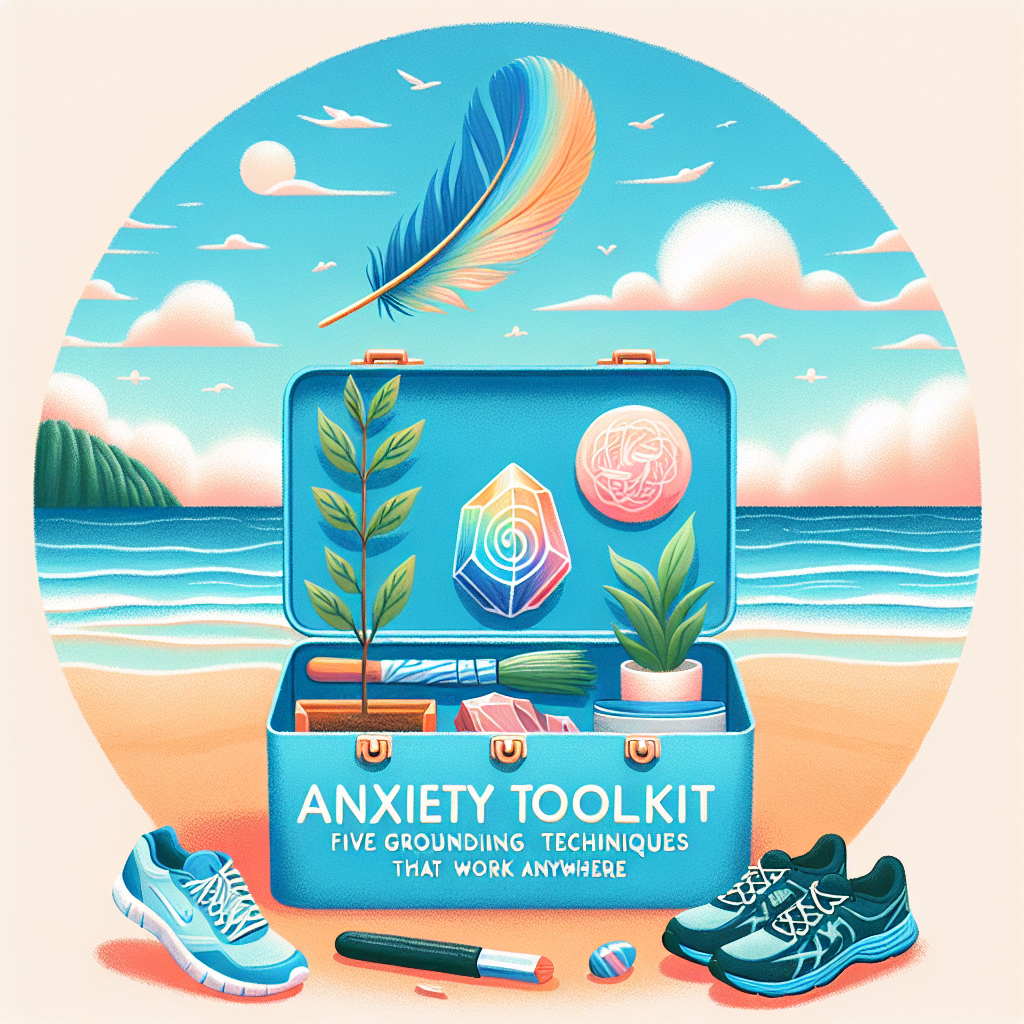
Simple, discreet tools to steady your body and mind—whether you’re at your desk, on a bus, in a meeting, or standing in line.
Why grounding helps
When anxiety spikes, your nervous system shifts into threat mode. Grounding techniques redirect attention to the here-and-now and give your body signals of safety—slowing heart rate, easing muscle tension, and quieting racing thoughts. The key is to pick short, repeatable actions that feel doable wherever you are.
Five grounding techniques you can use anywhere
1) 5–4–3–2–1 Senses Scan
Engage each sense to anchor your attention in the present.
- Look around and name 5 things you can see.
- Notice 4 things you can feel (clothing, chair, floor, temperature).
- Identify 3 things you can hear (near and far sounds).
- Find 2 things you can smell (or recall two pleasant scents if none are present).
- Notice 1 thing you can taste (or sip water; or simply notice your mouth).
2) Box Breathing (with easy alternatives)
Steady, even breathing tells your nervous system it’s safe.
- Exhale gently to empty.
- Inhale through your nose for 4.
- Hold for 4.
- Exhale through your mouth for 4.
- Hold for 4. Repeat 4–6 cycles.
3) Feel Your Feet + Release
Use contact with the ground and a quick muscle reset to lower arousal.
- Sit or stand tall. Place both feet flat. Notice where they meet the floor.
- Press your feet down for 3 seconds; release for 3. Repeat twice.
- Unclench your jaw; drop your shoulders; soften your hands.
- Name 1–2 sensations: “Left foot warm, right heel firm.”
4) Object Anchor
Focus on a small item to channel anxious energy into neutral details.
- Pick an everyday object (ring, key, pen, card).
- Quietly study it for 30–60 seconds: texture, weight, edges, temperature, color, any marks.
- Describe 3 facts in your mind: “Cool metal, smooth edge, two ridges.”
- Pair with a slow breath or thumb-to-finger press.
5) Orienting Statement + Neutral Description
Remind your brain what’s true right now and narrate without judgment.
- Silently say an orienting statement: “I’m safe enough right now.” “I’m in my office, Tuesday morning.”
- Describe your scene in simple facts for 20–30 seconds: “Gray desk, two monitors, soft chair, faint traffic noise.”
- If thoughts intrude, gently return to describing the next neutral detail.
How to choose the right tool in the moment
- Racing thoughts or restlessness: try Box or 4–6 breathing, then Feel Your Feet.
- Foggy or detached (dissociation): use Senses Scan or Object Anchor with strong tactile focus.
- In public or during a conversation: choose subtle options—slow exhale, micro foot press, anchoring statement.
- Short on time: do one minute of any technique; even 3 slow breaths can shift your state.
Troubleshooting common pitfalls
- Breathwork makes you dizzy: skip holds; lengthen exhale; breathe through the nose; sit down.
- Can’t focus: lower the bar. Do a “2–2–2” senses scan or describe just one object for 20 seconds.
- Sensory overload: close or soften your gaze and focus on internal sensations (feet pressure, breath in belly).
- Negative self-talk pops up: notice it, then return to neutral facts. Avoid debating thoughts while grounding.
Make it stick: a 2-minute daily practice
- Pick one technique per week.
- Practice for 2 minutes at a calm time each day (after coffee, before email).
- Save a cue on your phone or place your touchstone where you’ll see it.
- When anxiety hits, your practiced technique will be easier to access.
Quick reference
- 5–4–3–2–1 Senses: 5 see, 4 feel, 3 hear, 2 smell, 1 taste.
- Breathing: Box 4–4–4–4 or inhale 4, exhale 6.
- Feet + Release: press feet 3 seconds, relax, drop shoulders.
- Object Anchor: notice texture, weight, temperature; name 3 facts.
- Orient + Describe: “I’m here, it’s [day],” then neutral details.
When to seek more support
Grounding tools are skills, not cures. If panic, intrusive thoughts, or avoidance are disrupting your daily life, consider reaching out to a mental health professional. If you’re in immediate danger or thinking about harming yourself, contact local emergency services or a crisis line in your region right away.