
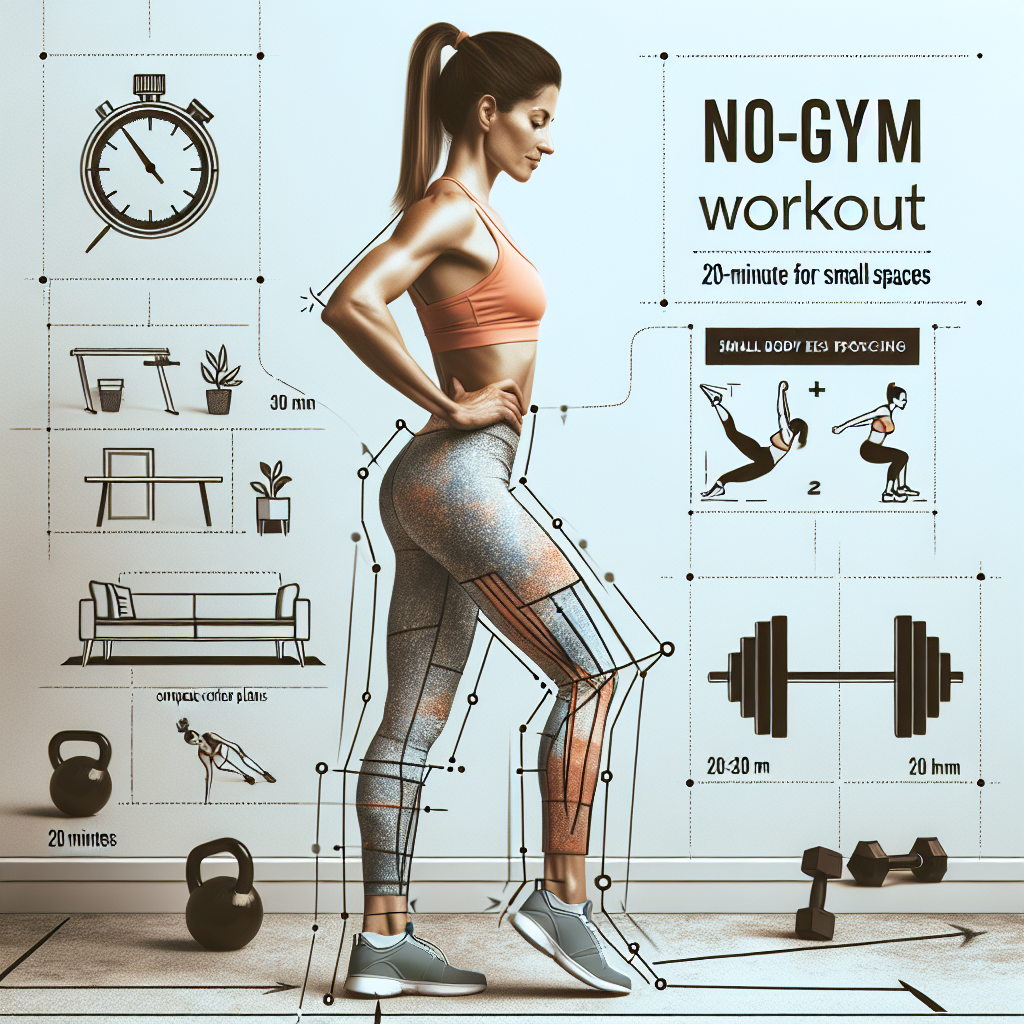
Short on space and time? These 20-minute plans deliver total-body strength, mobility, and cardio without equipment or jumping. Each plan fits in a 6×6 ft area, works in socks or sneakers, and has quiet-friendly options for apartments.
Quick Start
- Space: Clear a rectangle roughly the length of your body.
- Gear: Optional backpack (load with books), towel, stable chair, or wall.
- Intensity guide: Aim for RPE 6–8 out of 10 during work periods.
- Structure: 3-minute warm-up + 15-minute main set + 2-minute cool-down.
- Quiet-friendly: Swap any jumps for marches, calf raises, or step-backs.
How the 20 Minutes Break Down
- Warm-Up (3 minutes): Prepare joints and raise heart rate gently.
- Main Set (15 minutes): Choose one plan (A, B, or C) below.
- Cool-Down (2 minutes): Downshift your breathing and stretch key areas.
Tips: Move with control, keep a neutral spine, and stop if you feel sharp pain. If you’re new to exercise or returning from injury, get medical clearance first.
3-Minute Warm-Up (no jump, tiny-space)
- 30s March in place with arm swings
- 30s Squat-to-stand: grab toes, sink hips, raise chest
- 30s Hip hinge sweeps: hands on thighs, hinge and stand tall
- 30s Arm circles + shoulder rolls (15s each direction)
- 30s Ankle rocks and calf pumps
- 30s Inchworm walkout to high plank (or wall plank hold)
Plan A: Classic Circuit (15 minutes total)
Timer: 5 moves, 45 seconds work / 15 seconds transition, 3 rounds (5 minutes per round).
- Squat or Sit-to-Stand
- Cues: Feet shoulder-width, push knees out, chest up.
- Easier: Sit-to-stand from a chair. Harder: Add backpack hold.
- Push-Ups (wall, counter, or floor)
- Cues: Body in a straight line, elbows ~45° from torso.
- Easier: Wall or counter push-ups. Harder: Slow 3-second lowering.
- Hip Hinge: Good Mornings or Backpack Deadlift
- Cues: Hinge at hips, slight knee bend, flat back, stand tall.
- Easier: Bodyweight hinge. Harder: Hold loaded backpack.
- Row: Towel Row or Backpack Row
- Option 1: Loop towel around a sturdy anchor (table leg), sit back, row chest to hands. Test anchor first.
- Option 2: Single-arm backpack row, one hand on chair for support.
- Core: Plank with Shoulder Taps or Dead Bug
- Plank option: Wide feet, tap opposite shoulder without swaying.
- Dead bug: On back, ribs down, extend opposite arm/leg with control.
Quiet-friendly swap: Replace any high-impact move with marching, step-backs, or calf raises.
Plan B: EMOM Strength Stamina (15 minutes)
EMOM = Every Minute On the Minute. Perform the reps, rest in the time left. Cycle through 5 moves, 3 rounds.
- Minute 1: 12–20 Air Squats
- Minute 2: 6–12 Push-Ups (wall/counter/floor)
- Minute 3: 10–16 Reverse Lunges total (or split squats)
- Minute 4: 10–15 Backpack or Towel Rows
- Minute 5: 20–40 seconds Hollow Hold or Dead Bug
Adjust reps so you finish with 15–20 seconds to spare. Increase reps or load as it gets easier.
Plan C: Strength–Flow Ladder (15 minutes)
Set a 15-minute timer. Flow through 3 moves in a ladder: 1–2–3–4–5 reps, then back to 1, repeating until time. Move smoothly with minimal rest.
- Walkout to Push-Up: From standing, hinge, walk to plank, 0–1 push-up, walk back and stand.
- Squat to Calf Raise: Sink into squat, rise and lift heels.
- Glute Bridge March: Bridge up, alternate knee lifts without dropping hips.
Progressions: Add a backpack for squats/bridges, or pause 2 seconds at the hardest point of each rep.
2-Minute Cool-Down
- 30s Box breathing: Inhale 4, hold 4, exhale 4, hold 4.
- 30s Calf and ankle stretch against wall or step.
- 30s Hip flexor stretch (half-kneeling, tuck pelvis gently).
- 30s Chest/shoulder stretch (doorway or arm behind back).
Make It Yours
- No equipment: Use wall push-ups, dead bugs, good mornings, and isometric towel pull-aparts.
- Knee-friendly: Swap lunges for split squats or sit-to-stands; keep ranges small and controlled.
- Wrist-friendly: Use fists/handles for push-ups or do wall variations; choose dead bug over plank.
- Low noise: Marches, step-backs, calf raises, isometric wall sits instead of jumps.
- Small space: Favor in-place moves (split squats over forward lunges, walkouts over burpees).
Progress and Weekly Plan
- Progress options: Add 1–2 reps per set, slow the lowering phase to 3 seconds, add backpack load, or reduce rest slightly.
- Sample week: Mon Plan A, Wed Plan B, Fri Plan C. Add a 10–15 minute walk or mobility on off days.
- Tracking: Note reps completed, RPE, and any modifications. Aim for small, steady improvements.
Form Cues That Work Everywhere
- Spine: Long neck, ribs stacked over pelvis, neutral back.
- Knees: Track over middle toes; let them move forward naturally in squats.
- Hinge: Push hips back; feel hamstrings load, not your lower back.
- Push/Pull: Shoulders down and back; move through full, controlled ranges.
- Breathe: Exhale through effort; don’t hold your breath.


