
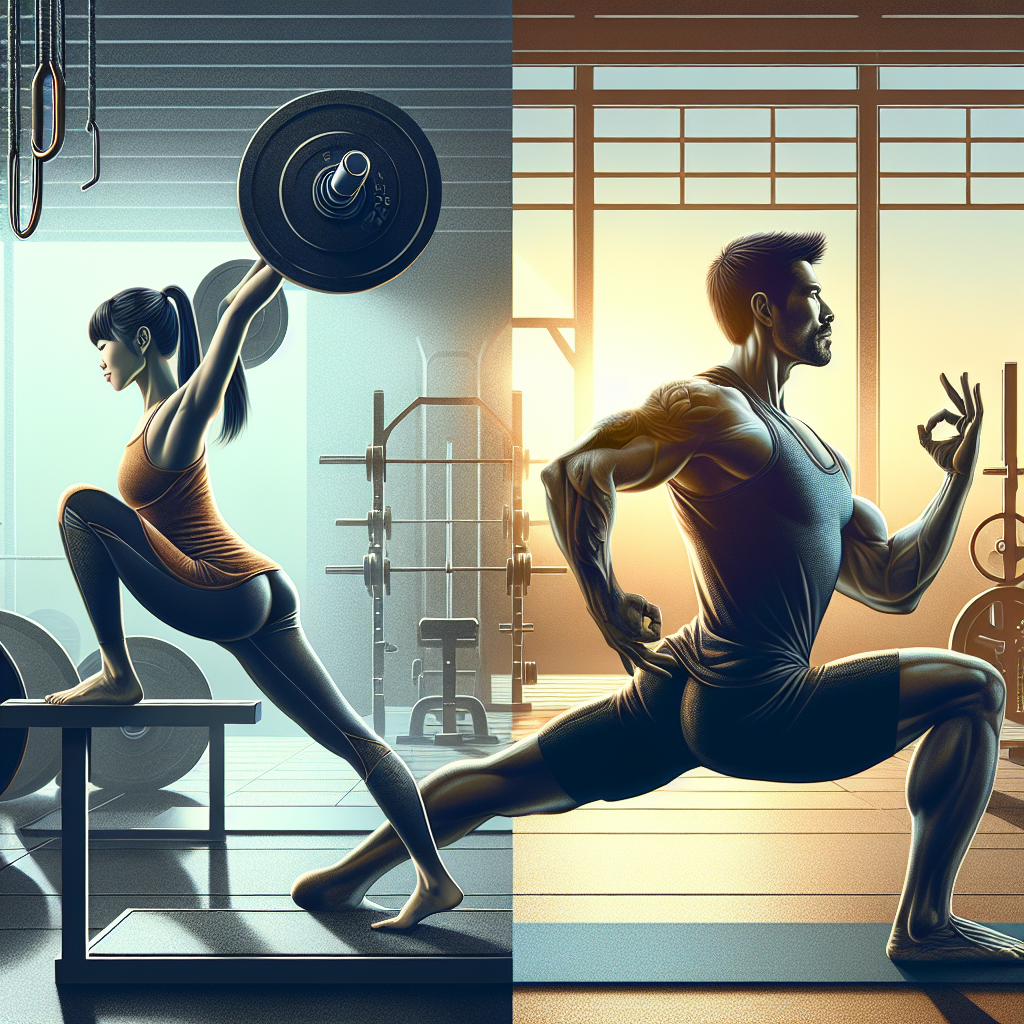
Make your mobility work serve your barbell. These yoga poses and mini-flows target the joints and tissues that limit strength performance—without turning your training into a stretching session.
Why yoga helps lifters
- Increases usable range of motion where you need it: ankles, hips, thoracic spine, shoulders.
- Improves end-range strength and control, reducing compensations under load.
- Enhances recovery by downregulating the nervous system on off days.
- Sharpens positional awareness and bracing, leading to more efficient technique.
Principles for lifters
- Be specific: choose poses that target the limitations of your main lifts.
- Use dynamic, low-intensity mobility before lifting; save longer holds for after or on off days.
- Own the range: lightly contract in new ranges rather than slumping into passive end range.
- Prioritize consistency: 8–12 minutes before sessions and 20–30 minutes 1–3 times weekly on off days beats marathon sessions.
- Respect max days: avoid deep static holds immediately before 1RM attempts.
Key poses that improve your lifts
For the Squat (depth, knees tracking, upright torso)
-
Malasana (Garland Squat)
- How: Feet slightly wider than hips, toes turned out as needed. Sink into a deep squat, elbows inside knees, hands at heart. Lift chest.
- Why it helps: Opens ankles, adductors, and hips for depth and knee tracking.
- Make it active: Press knees into elbows and elbows into knees for 5-second holds.
- Regression: Sit on a block or hold a post for balance; place small heel wedges if ankles are tight.
-
Low Lunge with Posterior Tilt (Anjaneyasana)
- How: Back knee down, tuck pelvis (tailbone toward floor), ribs down. Reach arms overhead without flaring.
- Why: Lengthens hip flexors to reduce butt wink and forward torso lean.
- Add: Gentle forward knee drive over toes to bias ankle dorsiflexion on the front leg.
-
Chair Pose with Heel Lift (Utkatasana)
- How: Feet hip-width, sit back and down, spine long. Lift heels 1–2 cm, keep knees over toes.
- Why: Trains quads and mid-foot stability in a squat-like pattern with torso control.
-
Prone Figure Four (Reclined Pigeon)
- How: On back, cross ankle over opposite knee, draw legs toward chest.
- Why: External rotation range for knee tracking and hip comfort at depth.
For the Deadlift (hip hinge, hamstrings, lats)
-
Half Splits (Ardha Hanumanasana)
- How: From low lunge, send hips back over rear knee, front leg straight, hinge forward with flat back.
- Why: Hamstring length and hinge patterning without spinal flexion.
- Active: Pull the heel back isometrically as if dragging the mat.
-
Wide-Leg Forward Fold with Flat Back (Prasarita Padottanasana)
- How: Feet wide, hinge at hips to a long spine. Hands to blocks if needed.
- Why: Grooves hip hinge and adductor length for sumo setups.
-
Locust (Salabhasana)
- How: Prone, lift chest, arms, and legs slightly; lengthen through crown and heels.
- Why: Posterior chain activation, spinal extension endurance for a strong finish.
-
Thread the Needle (Parsva Balasana)
- How: From tabletop, slide one arm under the other, rest shoulder and side of head, rotate gently.
- Why: Thoracic rotation mobility to hold a neutral spine and set lats without overextending low back.
For the Bench Press (shoulder external rotation, T-spine extension, scapular control)
-
Puppy Pose on Blocks (Uttana Shishosana)
- How: Knees under hips, forearms or hands on blocks in front, sink chest while keeping ribs tucked.
- Why: Opens thoracic extension and shoulder flexion for a solid arch and bar path.
-
Cow Face Arms (Gomukhasana Arms) with Strap
- How: One elbow up, one down, connect hands with a strap behind back.
- Why: Improves shoulder external rotation and internal rotation balance for safe bottom position.
-
Sphinx to Low Cobra
- How: Prone on forearms (Sphinx), gently press chest forward; optional small lift to Low Cobra.
- Why: Thoracic extension for bench arch without compressing lumbar spine.
For the Overhead Press and Pull-Ups (overhead mobility, scapular upward rotation, core)
-
Downward-Facing Dog (Adho Mukha Svanasana)
- How: Hands shoulder-width, hips high, press through palms, lengthen spine. Bend knees to keep back flat.
- Why: Shoulder flexion, lat length, and scapular upward rotation for efficient overhead work.
- Regression: Hands on a wall or bench for a more upright angle.
-
Side Plank (Vasisthasana)
- How: Stack feet, press floor away, ribs down, top arm to sky.
- Why: Lateral core and shoulder stability for strict pressing and pull-up control.
-
Eagle Arms (Garudasana Arms)
- How: Wrap one elbow over the other, forearms together, lift elbows slightly.
- Why: Scapular protraction and upper back stretch to balance heavy retraction work.
For Ankles and Knees (squat depth, stable knee travel)
-
Kneeling Ankle Rocks
- How: Half-kneeling, front foot flat. Drive front knee forward over toes, keeping heel down. Pulse.
- Why: Dorsiflexion for deeper, more upright squats.
-
Skandasana (Side Lunge)
- How: Wide stance, shift into one hip, other leg straight, toes up.
- Why: Adductors and ankle mobility for sumo and lateral stability.
For Core and Bracing
-
Forearm Plank with Breath
- How: Elbows under shoulders, ribs down, slight posterior pelvic tilt. Inhale 360°, exhale to brace.
- Why: Teaches diaphragmatic bracing you can transfer to any lift.
-
Boat Pose (Navasana)
- How: Balance on sit bones, shins parallel, long spine. Progress to straight legs.
- Why: Anterior core endurance for maintaining positions under load.
Short flows you can use today
8–10 minute pre-squat flow
- Cat–Cow x 6 slow cycles.
- Down Dog with calf pedals x 45–60 seconds.
- Low Lunge with posterior tilt x 5 breaths each side; add 8–10 knee-over-toes pulses.
- Half Splits x 5 slow breaths each side with gentle heel-drag isometric.
- Malasana x 60–90 seconds, alternating gentle knee presses and chest lifts.
- Chair Pose x 30–45 seconds, finish with 3–4 practice goblet squats.
8–10 minute pre-deadlift flow
- Prone Sphinx x 5 breaths, then Locust x 2 sets of 20–30 seconds.
- Thread the Needle x 4 breaths each side.
- Half Splits x 5 breaths each side with active heel drag.
- Wide-Leg Forward Fold with flat back x 45–60 seconds; hinge up and down 5 reps.
- Tall-kneeling lat stretch at bench x 5 breaths.
20–25 minute off-day recovery flow
- Sun Salutation A x 3 rounds at easy pace.
- Lizard Lunge x 6 breaths each side; option to add gentle twists.
- Puppy Pose on blocks x 6–8 breaths.
- Skandasana flow side to side x 8–10 passes.
- Pigeon or Reclined Figure Four x 60–90 seconds each side.
- Gomukhasana Arms with strap x 45–60 seconds each side.
- Side Plank x 25–35 seconds each side.
- Boat Pose x 2 sets of 20–30 seconds.
- Box-breathing in constructive rest (on back, knees bent) x 3–5 minutes.
Programming and timing
- Before lifting: 5–12 minutes, dynamic and active, short holds (15–30 seconds), light intensity.
- After lifting: 5–10 minutes of gentle mobility to restore range and downregulate.
- Off days: 20–30 minutes, longer holds (45–90 seconds), breathe slowly, add light isometrics.
- Frequency: 4–7 short sessions per week beats 1 long session.
- On max effort days: reduce ROM chasing; focus on activation and position primers.
Modifications for tight or big bodies
- Use blocks or a bench to bring the floor up in lunges, forward folds, and Down Dog.
- Reclined Figure Four instead of floor Pigeon if knees or hips are sensitive.
- Malasana with heel wedges or plates; hold a rack post for balance.
- Gomukhasana Arms with a strap or towel; wall slides if shoulders are irritable.
- Puppy Pose: support chest with a bolster, keep ribs down to avoid low-back pinch.
Breathing and bracing carryover
- In poses: inhale through the nose to expand ribs 360° (front, sides, back). Exhale gently and feel ribs descend.
- For bracing: take a 360° inhale, set the ribcage over pelvis, lightly contract glutes and abdominals, then hold that pressure as you initiate the lift.
- Cues to keep: ribs down, pelvis neutral or slight posterior tilt, long spine, active hands/feet.
How to track progress
- Ankle dorsiflexion: knee-to-wall test distance increases over weeks.
- Overhead: wall-facing shoulder flexion improves without rib flare.
- Squat: depth at same stance with neutral spine and heels down.
- Press: less lumbar extension needed to get bar overhead.
- Subjective: reduced hip pinch, shoulder tightness, or low-back fatigue post-session.
- Performance: smoother bar path, lower RPE at given loads, fewer missed reps at end range.
FAQ
Will yoga make me weaker? No—when programmed intelligently. Keep pre-lift work short and active; save long static holds for after or off days.
How long until I notice changes? Many lifters feel immediate improvements in positions. Sustainable changes in ROM and control typically show in 2–6 weeks of consistent practice.
What if a pose hurts? Stop and modify. You should feel stretch or muscular effort, not sharp pain or joint pinching.