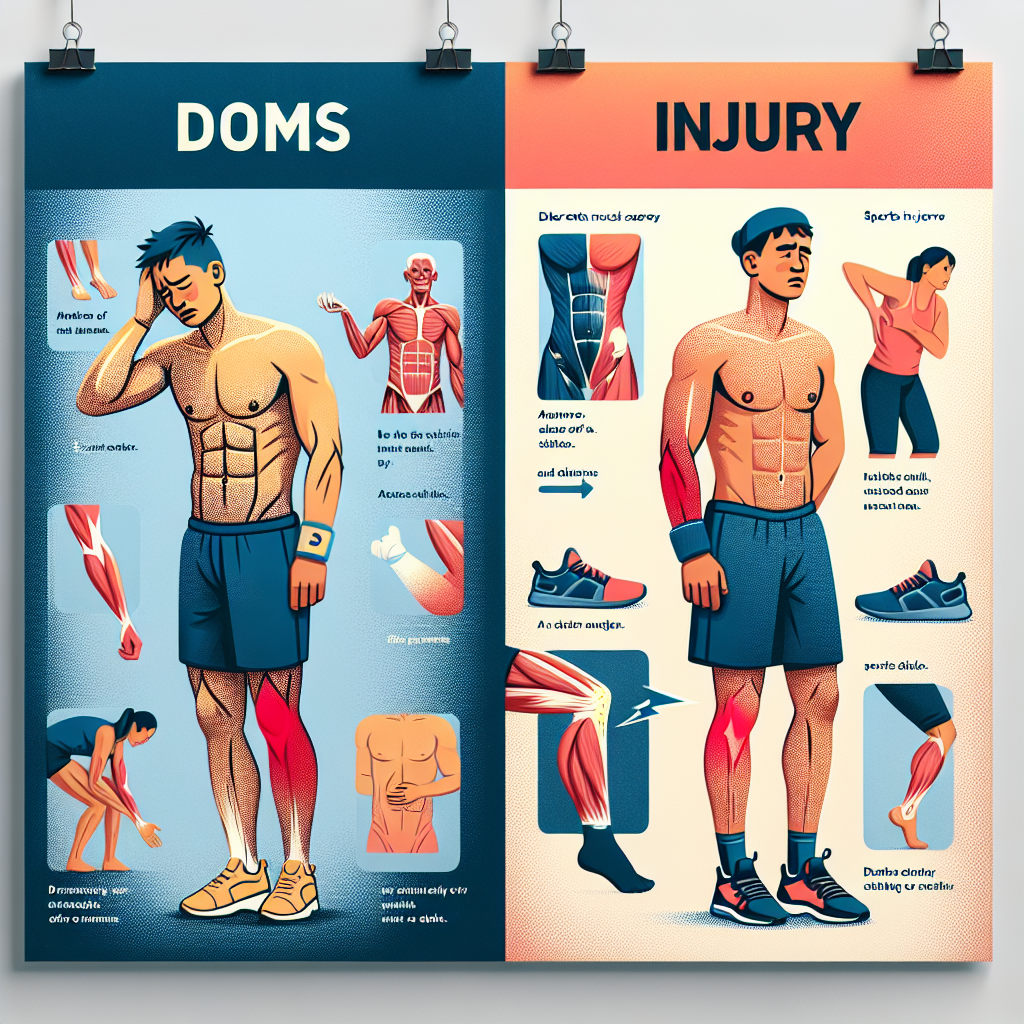
After a tough workout it can be hard to know whether you’re feeling normal soreness or dealing with an actual injury. This guide explains how to tell the difference and what to do in each case.
Quick take
- DOMS: sore, stiff muscles that start 12–24 hours after unfamiliar or hard exercise, peak at 24–72 hours, and fade within 3–7 days. Usually diffuse, improves with light movement.
- Injury: sharp or focal pain often during activity or immediately after, may cause swelling, bruising, weakness, or instability. Pain persists or worsens with activity.
- When in doubt: stop the provoking activity, monitor 24–48 hours, and treat as an injury until it clearly improves.
What is DOMS?
Delayed-onset muscle soreness (DOMS) is a normal response to novel or high-load exercise, especially eccentric work (like downhill running, lowering weights, or plyometrics). Micro-damage, inflammation, and fluid shifts sensitize nerves in the muscle. It is uncomfortable but not dangerous.
- Onset: 12–24 hours after exercise
- Peak: 24–72 hours
- Resolution: 3–7 days (sometimes up to 10 after very unaccustomed work)
What counts as an injury?
Injuries involve structural tissue damage or overload that outpaces recovery.
- Muscle strain (Grade I–III): sudden sharp pain at the time of effort; possible swelling, bruising, weakness, or a palpable gap in severe cases.
- Ligament sprain: pain and swelling around a joint, possible popping sensation, instability or giving way.
- Tendinopathy: load-related tendon pain that is focal, may “warm up” with activity but flares later; usually develops over weeks.
- Bone stress injury (stress reaction/fracture): focal bone ache that worsens with impact, night or rest pain, and tenderness to a fingertip-sized area.
How to tell DOMS from an injury
More like DOMS if
- Pain started the next day, not during the activity.
- Soreness is diffuse across the muscle belly and often on both sides.
- Stiff early in the day but eases with gentle movement or a warm-up.
- Little to no swelling or bruising.
- Strength is slightly reduced due to soreness, but no sudden loss or “giving way.”
- Passive stretch is uncomfortable but tolerable; light activity feels okay.
More like injury if
- There was a sharp, pinpoint pain during the activity or right after.
- Pain is focal at a joint line, tendon, or a fingertip-sized spot on bone.
- Noticeable swelling, warmth, or bruising, especially within 24–48 hours.
- Instability, limping, or a clear strength deficit compared to the other side.
- Clicking, catching, or a popping sensation at the time of pain.
- Pain increases with activity and does not improve with an extended warm-up.
Red flags: seek urgent care
- Severe pain, visible deformity, or inability to bear weight or use the limb.
- Rapid, significant swelling of a joint or a large area.
- Numbness, tingling, or loss of function.
- Night pain that doesn’t ease, fever, chills, or feeling unwell.
- Very dark (tea/cola-colored) urine, extreme muscle tenderness and swelling after exertion (possible rhabdomyolysis).
60-second self-checks
- Palpation: DOMS feels broad and achy over a muscle; injuries feel sharp and focal.
- Hop test (for bone/joint issues): single-leg hop. Sharp focal pain suggests injury; dull diffuse ache suggests DOMS. Do not perform if you already have significant pain or swelling.
- Resisted contraction vs passive stretch: sudden sharp pain and clear weakness on resisted contraction points toward a strain; DOMS is less sharp and more “stiff.”
- Warm-up response: pain that improves substantially after 5–10 minutes of easy movement favors DOMS; pain that worsens or causes limping favors injury.
If it’s likely DOMS: what to do
- Keep moving: light, pain-guided activity (walking, easy cycling, mobility drills) speeds recovery.
- Reduce load: for the next 1–3 sessions, cut intensity/volume by 30–50%, avoid heavy eccentrics and maximal efforts.
- Hydrate, eat, and sleep: target protein 1.6–2.2 g/kg/day, adequate carbs for training, and 7–9 hours of sleep.
- Short-term relief: gentle foam rolling and light massage may reduce soreness perception; brief heat before activity can help stiffness.
- Pain meds: consider avoiding routine NSAIDs early—they may blunt muscle adaptation. If needed for comfort, use the lowest dose for the shortest time. Consult your clinician if you have medical conditions or take other medications.
- Expect resolution within a week. If soreness persists beyond 7–10 days or worsens, reassess for injury.
If you suspect an injury: what to do
In the first 1–3 days, follow PEACE; then progress to LOVE as symptoms allow.
PEACE (first 1–3 days)
- Protect: stop provoking activities; use relative rest.
- Elevate: above heart level when possible to reduce swelling.
- Avoid anti-inflammatory meds/modalities in the very acute phase if you can; they may impair tissue healing. Use short, intermittent ice only for pain relief if helpful.
- Compress: elastic wrap or sleeve to manage swelling.
- Educate: imaging is rarely needed initially; healing takes time.
LOVE (after 48–72 hours and improving)
- Load: reintroduce pain-guided activity. Keep pain during and the next day at 3/10 or less.
- Optimism: expectations matter—most soft-tissue injuries recover well.
- Vascularization: add low-impact cardio to promote blood flow.
- Exercise: progress mobility, strength, and balance specific to the tissue injured.
Seek evaluation from a qualified clinician if pain is severe, function is limited, symptoms persist beyond 7–10 days, or red flags are present.
Special cases to know
- Tendinopathy: localized tendon pain that improves slightly after warming up but flares later or the next day. Management focuses on load management and progressive heavy slow resistance—not rest alone.
- Bone stress injury: focal bone tenderness, pain with hopping or impact, and pain that worsens with activity. Stop impact loading and see a clinician; do not try to “run through it.”
- Rhabdomyolysis: rare but serious. After extreme exertion, watch for severe muscle pain and swelling plus dark urine and malaise. Go to urgent care or the ER.
Return-to-training benchmarks
- DOMS: resume normal training once pain during and the day after is mild (≤3/10) and not worsening. Ramp volume/intensity over 2–3 sessions.
- Injury: before full return, aim for pain-free daily activities, no swelling increase after workouts, near-symmetric range of motion, and at least 90% strength or performance compared to the other side on simple tests relevant to your sport.
Prevention tips
- Progress gradually: increase volume or intensity by about 5–10% per week; add eccentric loads slowly.
- Warm up: 5–10 minutes of easy cardio plus dynamic movements specific to your session.
- Technique and variety: good movement patterns and balanced training reduce overload.
- Recovery basics: nutrition, hydration, and consistent sleep are non-negotiable.
- Supportive strategies: compression garments or short bouts of foam rolling can modestly reduce soreness.
Medication and medical considerations
- NSAIDs can reduce pain but may impair early healing and muscle adaptation; use sparingly and discuss with a clinician if unsure.
- If you are on statins, fluoroquinolone antibiotics, or have metabolic or kidney conditions, consult a clinician early for muscle or tendon pain.