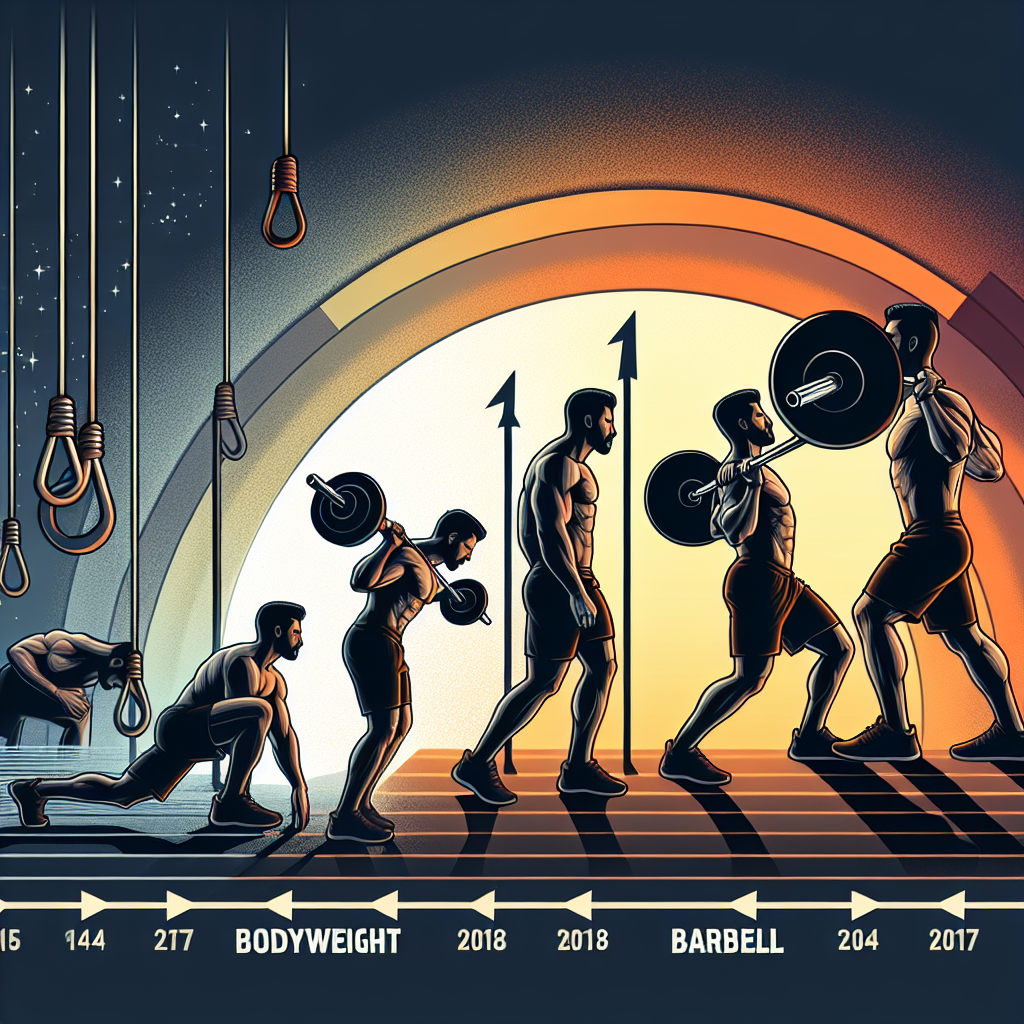
Build resilient strength in three phases—from confident bodyweight basics to proficient barbell lifting—no fluff, just a clear plan.
3 days/week
45–70 minutes/session
Contents
Overview & Who It’s For
This program guides you from bodyweight movements to barbell proficiency in 12 weeks. You’ll train three non-consecutive days per week (e.g., Mon/Wed/Fri) using a simple A/B rotation built around six patterns: squat, hinge, push, pull, carry, and core.
Equipment & Setup
- Weeks 1–4: A sturdy chair/bench, a backpack (to load with books), a towel or band, a space to do rows (table/TRX) and push-ups.
- Weeks 5–8: Dumbbells or a kettlebell (10–35 lb+), resistance bands.
- Weeks 9–12: Barbell, plates (including 2.5–5 lb), rack with safeties, bench. If no barbell, continue with heavier DB/KB progressions.
Week 0 Assessment (15–20 minutes)
Establish a baseline so you can scale difficulty correctly.
- Push-Ups: max strict reps (or incline height where you can do 6–10).
- Rows: table/TRX rows at an angle where you can do 6–10.
- Squat Pattern: 10 bodyweight box squats to a target height with knees tracking over toes.
- Hinge Pattern: hip hinge drill with a dowel/broomstick keeping head–mid-back–tailbone contact.
- Core: front plank, max 30–60s without losing position.
Warm-Up & Session Template
Warm-Up (8–10 min)
- 2–3 min easy cardio (walk/row/bike/jump rope).
- Dynamic mobility: ankle rocks, hip openers, T-spine rotations (1–2 sets of 6–10 each).
- Primer: 1 light set of your first two lifts for 8–10 reps.
Ramp-Up Sets (barbell days)
- Set 1: 5 reps with empty bar or very light load.
- Set 2: 5 reps at ~50% of work weight.
- Set 3: 3 reps at ~70%.
- Set 4: 1–2 reps at ~85%.
Session Template (45–70 min)
- Main Lower Pattern (squat or hinge)
- Main Upper Push
- Main Upper Pull
- Accessory (single-leg, posterior chain, upper back)
- Carry + Core Finisher
The 12-Week Plan
Phase 1 (Weeks 1–4): Bodyweight Foundations
Goal: own the movement patterns. Use a double-progression scheme across 6–10 reps; when you hit 10 reps on all sets, make the exercise slightly harder (lower the incline, add a backpack, deeper range).
Day A
- Box Squat to Target: 3×6–10
- Incline Push-Up: 3×6–10
- Hip Bridge or Single-Leg Bridge: 3×8–12
- Inverted Row (high angle): 3×6–10
- Farmer Carry (loaded backpack/DBs): 3×20–40 m
- Dead Bug or Plank: 3×6–10/side or 3×20–45s
Day B
- Step-Up (knee height you control): 3×6–10/leg
- Push-Up Eccentric (3–4s down) or Regular: 3×6–10
- Hip Hinge Drill + Backpack RDL: 3×8–12
- Inverted Row (slightly steeper): 3×6–10
- Suitcase Carry (one-sided): 3×15–30 m/side
- Side Plank: 3×15–30s/side
Progress each session by adding 1 rep per set until you hit the top of the range, then lower support (e.g., lower push-up incline) or add light load (backpack).
Phase 2 (Weeks 5–8): Dumbbell/Kettlebell Bridge
Goal: introduce external load and prep barbell technique. Work mostly at RPE 7–8 (stop with 2–3 reps in reserve). 2–4 sets each.
Day A
- Goblet Squat: 3–4×6–10 (RPE 7–8)
- DB Bench Press or Weighted Push-Up: 3×6–10
- DB RDL: 3×8–12
- 1-Arm DB Row: 3×8–12/side
- Farmer Carry (heavier): 3×30–50 m
- Plank Variations: 3×30–45s
Day B
- Split Squat or Rear-Foot-Elevated Split Squat: 3×6–10/leg
- Half-Kneeling 1-Arm Press (DB or band): 3×6–10/side
- Hip Thrust (DB/KB): 3×8–12
- Pulldown/Band-Assisted Pull-Up or Inverted Row: 3×6–10
- KB Swings (technique focus): 5×10 (light–moderate)
- Anti-Rotation Press (Pallof): 3×8–12/side
Phase 3 (Weeks 9–12): Barbell Emphasis
Goal: build consistent barbell patterns, using simple linear or small-step load progressions while keeping 1–3 reps in reserve.
Day A — Squat + Bench
- Back Squat: 3×5 @ RPE 7–8
- Bench Press: 3×5 @ RPE 7–8
- DB RDL or Back Extension: 3×8–12
- Chest-Supported Row or Lat Pulldown: 3×8–12
- Plank or Ab Wheel: 3×20–45s or 3×6–10
- Carry (farmer or suitcase): 3×30–50 m
Day B — Deadlift + Press
- Deadlift: 1×5 @ RPE 8, then 2×5 back-off at ~90%
- Overhead Press: 3×5 @ RPE 7–8
- Front-Foot-Elevated Split Squat: 3×8/leg
- Pull-Ups (assisted as needed) or Inverted Rows: 3×6–10
- Hip Thrust: 3×8–12
- Side Plank: 3×20–40s/side
Optional Day C (technique/upper back): Front Squat (light) 3×3, Incline DB Press 3×8–10, Barbell Row 4×6–8, KB Swings 5×10 EMOM, Pallof Press 3×10/side.
Progression Rules
- Double progression (Phases 1–2): add reps within the range each session; when you reach the top range for all sets, increase difficulty or load.
- Small load steps (Phase 3): add 2.5–5 lb per successful session for upper body; 5–10 lb for lower body if reps felt strong with 1–2 RIR.
- Autoregulate with RPE/RIR: if you can’t keep 1–3 reps in reserve, keep the same weight next time or reduce load by 5–10% to complete target reps with good form.
- Stalls: if you miss reps two sessions in a row, drop load 5–10% and rebuild.
Form Cues that Matter
- Brace: inhale 360° into belly and sides, lightly “lock” the abs; exhale between reps if needed.
- Squat: full foot on floor, knees track over toes, hips and chest rise together.
- Hinge: neutral spine; push hips back; bar stays close to legs.
- Bench: eyes under bar, shoulder blades tucked, slight arch, feet planted, consistent touchpoint.
- Press: squeeze glutes, ribs down, press in a straight line, move head “through” after the bar passes the forehead.
- Deadlift: bar over midfoot, lats tight (bend bar to shins), push the floor away, lock out with glutes, not low-back lean.
Recovery, Nutrition, Sleep
- Protein: ~1.6–2.2 g/kg bodyweight per day. Spread over 3–5 meals.
- Calories: aim for maintenance to slight surplus if strength gain is priority (+200–300 kcal/day).
- Hydration: ~30–40 ml/kg/day; more if hot/sweaty.
- Sleep: 7–9 hours nightly; keep a consistent schedule.
- Supplements (optional): creatine monohydrate 3–5 g/day; vitamin D if deficient; caffeine pre-workout if tolerated.
- Soreness: mild–moderate DOMS is normal; severe soreness >72 hours suggests volume/load is too high—adjust 10–20% down.
Week 12 Testing & What’s Next
Test with an AMRAP (as many reps as possible) set at RPE 9 to estimate 1RM safely, or test a heavy triple with perfect form.
- Option A: After warm-up, perform 1 top set of 3–6 reps at RPE 9. Use Epley:
e1RM = weight × (1 + reps/30). - Option B: Test 3RM. Stop if form deviates. Log the result; use 85–90% of e1RM for future programming.
Next steps: shift to an Upper/Lower split, continue small weekly load increases, or run this cycle again starting 5–10% heavier on Phase 2.
FAQ & Troubleshooting
Only 2 days per week?
Alternate A and B each session (Week 1: A/B, Week 2: A/B, etc.). Keep sets the same; progress more slowly.
No barbell access?
Continue with DB/KB versions: heavy goblet squat, DB RDL, DB bench/floor press, 1-arm rows, single-leg work, heavy swings, weighted carries. Use the same progression rules.
How hard should sets feel?
Most work sets end with 1–3 reps in reserve (RPE 7–9). You should feel challenged but not sloppy.
Pain vs. discomfort?
- Normal: muscle burn, mild symmetrical soreness.
- Concerning: sharp pain, joint pain, numbness, or pain that worsens each set—stop and assess, modify range/load, or consult a clinician.
Quick checklist for stalled lifts
- Sleep 7–9 hours? Protein >1.6 g/kg? Hydrated?
- Kept 1–3 RIR last session?
- Try a 5–10% deload for one week, then rebuild.
- Add a light day variation (front squat instead of back squat, paused bench, paused deadlift) to drive technique without over-fatiguing.